Showing posts with label Asian food. Show all posts

Saturday, November 8, 2008

Chop Suey & Elections '08

Photobucket

I am so glad that the elections are over. It was a drawn-out spectacle that left me really spent at the end of it all. It’s not just because the candidate I voted for didn’t win. It’s more because I’ve never been so much into all the drama that was the Elections ’08. In the last few weeks before the Election I felt burned-out; I wanted for everything to be over and done with. So you can just imagine how much anticipation I had on Election Day knowing that finally, the verdict will be revealed before the day ends.

Though disappointed of the fact that my candidate didn't make it, I have to admit that Obama’s triumph was a single event that changed the history of this nation. No doubt, it has impacted many a people’s lives not just in the US but all over the world. As I listened to him deliver his victory speech, I marveled at his charisma, that X-factor, if you may, that he possesses which attracted people to him, almost worshipping him like the Messiah. But more than that, I applaud him for all he has achieved. He has indelibly inked his name in history. My sincere congratulations to you, President-elect Obama.

Now, it is time to move on. I gladly wave adieu to all the political hustle and bustle that almost consumed me for a time. As a good citizen of this great nation, it is my responsibility to pledge support to our newly elected President in whatever capacity I can as an individual. I do hope and pray that he will have the wisdom that he needs to confront all the challenges that he will be facing when he takes office early next year.

Anyhow, enough about politics…….
Photobucket
Have you had those days when you want to eat something, yet you really don’t know what you want??? LOL… I had one of those days and that’s how this dish came about. I figured, I’ll just throw together my favorites (whatever I have anyways) and it should cure my unidentified craving. And I'm glad I did as this dish did really hit the spot!

I’ve mentioned in my earlier blogs that Philippine cuisine is heavily influenced by many cultures, predominantly Spanish and Chinese. Well, this one is an example of a Chinese-Filipino dish called Chop Suey.

Chop Suey or “mixed pieces” in Chinese consists of just that – stir-fried mixed pieces of vegetables with meat. In the Philippines, our Chop Suey version traditionally includes cabbage, chayote, cauliflower, carrots, red bell pepper, snow peas, fish ball, wood ear mushroom, quail eggs, shrimp and either chicken or pork.

Well, my version here is slightly different in that I just used whatever veggie I had on hand. Also in the Philippines, we usually eat this with plain boiled rice, but this time, I thought of pairing it up with cooked vermicelli (bean thread) noodles, chow mein style.

Let me tell you, this is certainly better than take-out. Any day. Any time.

Chop Suey (as shown here)
3 cloves garlic, minced
1 small onion, diced
1 /2 c vegetable oil
1/2 lb med sized shrimp*
1 med carrot, cut to about 1/4" thick
1 c cauliflower, cut into bite-size pcs
1 c broccoli, cut into bite-size pieces
1/2 c red bell pepper, cut into thick strips
8 oz fresh baby corn (or 1 8 oz can)
1/2 head of cabbage, cut into bite-size pcs
1 tsp of soy sauce (or more)
1 tbsp oyster sauce (or more)
1 tsp sugar
1/2 c water with 1 tsp of cornstarch
salt and pepper to taste
drizzle of sesame oil

1. Mix together the water, cornstarch, oyster sauce, sugar and soy sauce.
2. Heat a wok or skillet. Pour in about 2 tbsp of the cooking oil. Heat to smoking point.
3. Fry the carrots for 1-2 minutes. Remove with a slotted spoon, drain and paper towels and set aside. Repeat this process for the cauliflower, broccoli, baby corn, red bell pepper. Keep adding the cooking oil bit by bit as you saute your veggies, but set aside 1 tbsp.
4. When all the veggies have been stir fried, then add the last 1 tsbs of your cooking oil. Saute the onions till transluscent, and then add the garlic. Stir for 30 seconds. Then add the shrimp (or whatever meat you're using).
5. As soon as the shrimp turns pink (or your is meat cooked), return all the veggies to the wok/skillet, including the cabbage. Stir.
6. Then add the the cornstarch mixture. Stir until the sauce thickens and clears.
7. Adjust seasoning to your liking at this point. Add oyster sauce, if you want.
8. Season with pepper but be cautious with salt. Remember, the soy sauce and oyster sauce are already salty.
9. Turn off heat. Drizzle Chop Suey with sesame oil just before serving.
10. Best served warm, with rice or boiled vermiccili noodles.

* You may substitute shrimp with chicken or pork cut into bite-sized strips. To make a vegetarian version, substitute shrimp/meat with firm tofu cut into squares. I suggest marinating your tofu with soysauce for more flavor. Then saute tofu until golden brown.


Sunday, June 1, 2008

Siopao (Steamed Buns)


“Siopao or baozi” is a staple food in China that dates back to almost 1,800 years, about three kingdom periods (220-280) ago. According to history, some military soldiers caught a plague while traveling to South China. Zhuge Liang (181-234), the military strategist at that time, invented this food which is to be offered as a sacrifice to the gods for healing . They are buns shaped like human heads and are made of flour stuffed with meat filling. Interesting, huh?

Overtime, this food has become typical in Chinese households. They are usually served as dim sum, or those fingerfoods served with tea.


In the Philippines, siopao, along with mami (noodle-soup) and siomai (steamed dumpling) came from a tale of triumph by a Chinese immigrant named Ma Mon Luk. Ma Mon Luk is said to be a grade school teacher in China who was in love with a girl name Ng Shih. But the girl's family objected to their love, because Ma Mon Luk financially is not good enough. As a result, Ng Shih's father forbid her to marry Ma Mon Luk. Ng Shih had no choice but to obey her father regardless of her feelings for Ma Mon Luk.


Heartbroken, Ma Mon Luk decided to quit his teaching job and traveled to the Philippines in 1918. His purpose was to earn money, and be able to prove to Ng Shih's family that he was worthy of her.


It was not an easy feat for Ma Mon Luk. He was jobless and broke when he got to the Philippines. But he decided to use what he had - his rich culture and knowlege and did what he knew best, prepared the food he grew up with and began peddling them in the streets. With determination and hardwork, Ma Mon Luk succeeded in introducing dishes that were to become an indelible part of the Filipino's history, culture and diet - the mami, siomai and siopao.

Today, these remain to be among Filipino's favorites. And they are found in many Chinese restaurants in the country, as well as in most little eateries that dot the busy streets of the Philippines.

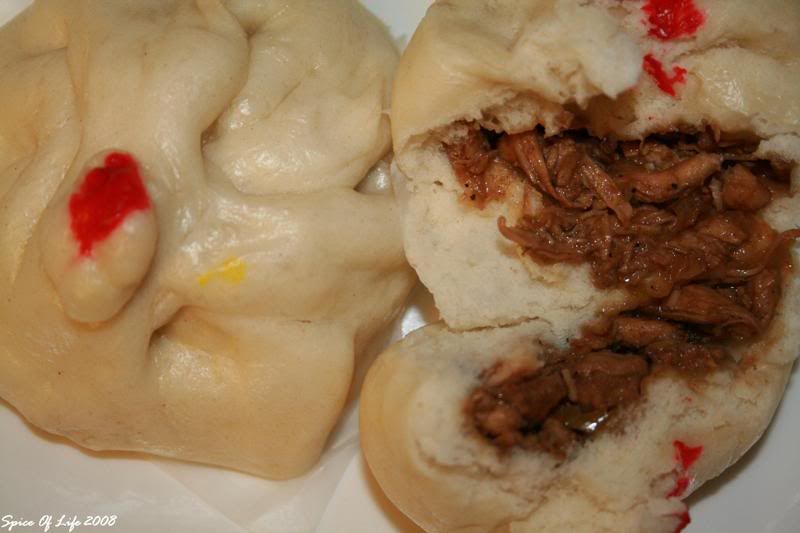
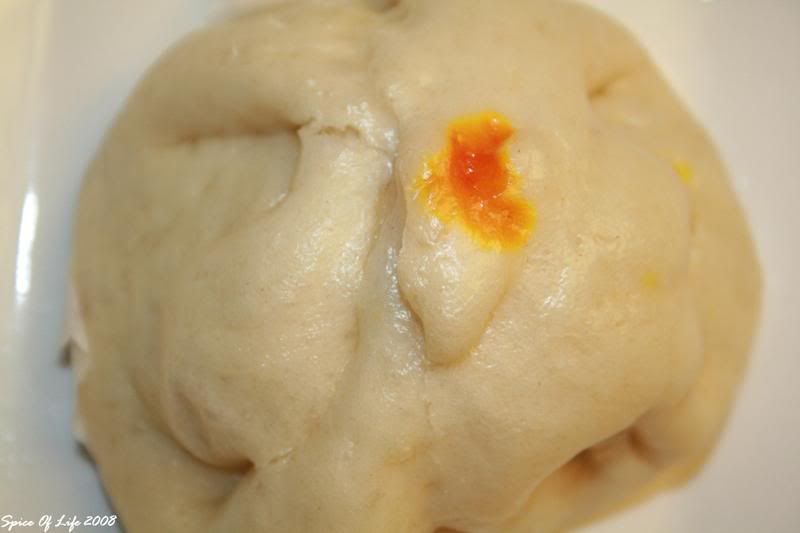
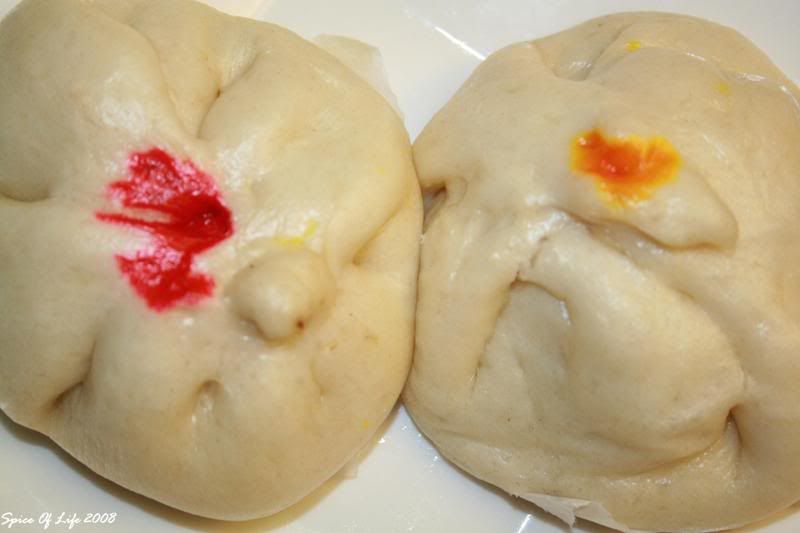
Bola-bola filled (meatball & egg) siopao

Chicken-filled siopao

As for me, Siopao is still one of my favorite snack food. Whenever I go back to my homeland, I never fail to have some of them. I love the soft, slightly sweet, almost cake-like dough. To me, the dough is what makes this dish.

I can always buy them frozen from every Asian grocery here in the U.S., but there is nothing like a home-made, fresh-from-the-steamer-siopao goodness. It may be bit time consuming to make, but the result is very rewarding.

Here I made two of my favorite filling, the meatball and the chicken. But there's a whole lot of other fillings for Siopao. You can substitute the chicken with pork. Or you can use Tofu and add some vegetables for a vegetarian siopao (using carrots, green beans, bean sprouts,cabbage). Another one of my favorite filling is using mashed Mung beans.

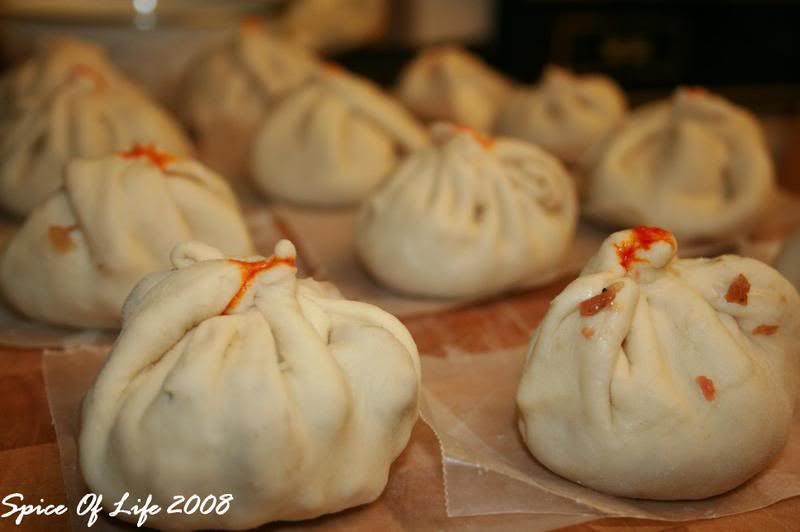
The food coloring on top is nothing but for me to identify the filling within. Here, the yellow is for the meatballs, and red is for the chicken.

Hmmn.. I'm glad I took the time make this. Even my husband enjoyed it. Hope you will too.

Siopao ready for steaming

SioPao

Dough:
1 cup warm water (about 100-110 degrees F)
3 tbsps sugar
1 package dry yeast (about 2-1/4 tsps)
3-1/4 cups all-purpose flour
3 tbsps canola oil
1/4 tsp salt
1-1/2 tsp baking powder
wax paper, cut into 2"x2" squares (about 12-20 pcs, depending on size of dough ball)

1. Combine warm water, sugar and yeast in a large bowl; let stand 5 minutes or until bubbly. DO NOT stir.
2. Spoon flour into the measuring cup and level with a knife. Add flour, oil and 1/4 tsp salt into yeast mixture. Mix well until soft dough forms.
3. Turn dough out into a floured surface. Knead until dough becomes smooth and elastic (about 10 minutes). Form into a ball.
4. Lightly oil/coat with cooking spray a large bowl. Place dough in the bowl, turning to coat top.
5. Cover with a clean, damp kitchen towel and let dough rise in a warm place (about 85 degrees F), for 2 hrs or until doubled in size. (Gently press two fingers into dough. If identation remains, dough has risen enough.)
6. Punch dough down; let rest 5 minutes. Turn dough out onto a clean surface; knead in baking powder. Let dough rest for 5 minutes.
7. Divide dough into two equal portions. Form one portion into a 10-inch log, and then cut into 5 equal pieces. Form each piece into a ball. Working with one dough ball at a time roll ball into a 4-5 inch circle. Make sure to cover remaining dough to keep them from drying.
8. Place about 1/4 cup of filling in the center of dough circle. Bring up sides to cover filling and meet on top.
9. Pinch and seal closed with a twist. Repeat procedure with rest of the dough.

Meatball Filling:
1 lb ground pork*
1 onion, finely chopped
1 tsp garlic, minced
1 med carrot, grated
3/4 tsp salt
1/2 tsp black pepper, freshly ground
2 eggs, beaten slightly
6 eggs, hard boiled, cooled and quartered

1. In a bowl, combine all ingredients except the ground meat and hardboiled eggs.
2. When mixed well, add ground pork to mixture. Mix by hand, only until all ingredients are thoroughly incorporated. Do not over work the meat.
3. Place about 1/4-cup of meat filling in the center of dough circle. Put quarter of the hard-boiled egg on top of the meat.
4. Proceed with #8 and #9 above.

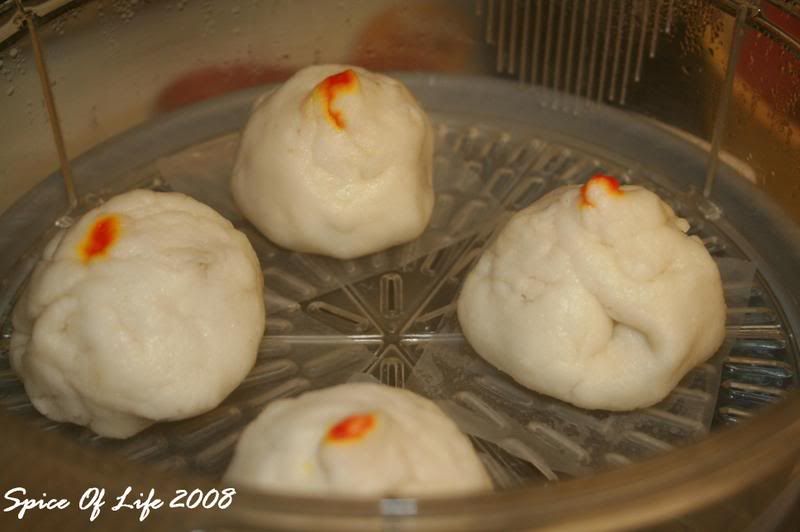
Siopao in the steamer

Chicken Filling:
1 lb chicken breast, boneless & skinless*
1/2 tsp five-spice powder
1 c green onions, thinly sliced
3 tbsps hoisin sauce
2 tbsps rice vinegar
1 tbsp soy sauce
1-1/2 tsp honey
1 tsp fresh ginger, minced
1 tsp garlic, minced
pinch of salt (be careful as soy sauce is already salty)
2 tbsps vegetable oil

1. Place chicken breasts in a pot. Add enough water to cover. Add dash of salt and pepper. Bring to boil. when boiling, reduce heat and allow to simmer until chicken is tender. Remove from water and let chicken cool.
2. When chicken is cool enough to handle, take two forks and shred the chicken into strips. Set aside.
3. Heat oil in a skillet. Saute onion till tender, then add garlic. Then add the cooked, shredded chicken and the rest of the ingredients.
4. Stir to mix and simmer for 2 minutes, or until bubbly.
5. Remove from heat to cool.
6. When cooled, add 1/4 of chicken to the dough circle. Do #8 and #9 procedures above under Dough.

Steaming:

1. Arrange bun in your steamer, 1 inch apart. Place wax paper on the bottom of each bun, seam side down (with me, I prefer to have the seam up, as it looks prettier).
2.If you are doing 2 or more fillings, I suggest that you color top with a food coloring to identify the filling in your buns.
3. If you are using a 2-tier bamboo steamer, stack tiers and cover with lid.
4. Add water to a large skillet to a depth of 1 inch; bring to a boil over medium high heat. Place steamer in pan; steam for 15* minutes until dough is puffed and set. Cool 10 minutes before serving.

*NOTE:

For meatball filling, steam 25 minutes since the meat is not pre-cooked.
If you are doing both fillings like I did, reduce the amount of the filling to half. Or, double the amount of your dough. Also, I added a 1/4 tsp vinegar to the steaming water. Vinegar has a bleaching effect on the dough when steaming, so you'll get whiter buns. For a gluten-free version, you may substitute the all-purpose flour with rice flour.

Saturday, February 16, 2008

Comfort Food

I have adjusted pretty well to eating american foods in that, I don't have to eat rice in every meal, everyday anymore. But nevertheless, I gotta have my comfort food once or twice a week, at least. This means rice, or something else that's familiar to me.

So last night, I decided to do a dish that I grew up with. This dish is what we call "lumpia" (pronounced as loom-pya) in our vernacular, or a.k.a. spring roll to the rest of the world. This dish and "pansit" (Filipino noodles) are the staple of every Filipino party. Go to a Filipino gathering and chances are, you will find this dish served on the table.
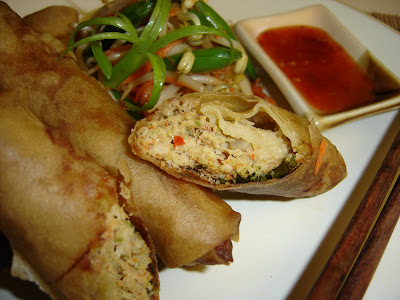
In the Philippines, there are 3 kinds of lumpia - the vegetable lumpia (veggie spring roll), the lumpia shang-hai (meat-filled spring roll) and the fresh lumpia (veggie filled but using a crepe-like wrap). As you can see, this time I chose to do the the meat-filled spring roll.

I learned to make this at an early age and have made this with my mother a countless number of times with her in the past. For this version, here's my recipe:

Lumpiang Shang-Hai
1 lb ground meat (beef,pork,chicken,turkey)
1/2 lb shrimp
1 med onion, chopped
1 med carrot, grated
1 pc red bell pepper, chopped
2 cloves garlic, minced
1 large egg, lightly beaten
Dash of red pepper flakes
1/4 cup soy sauce
2 tsps black pepper
1 tsp salt
1 (16 oz) package spring roll wrapper
1-1/2 quarts canola oil, for frying
Cilantro (optional)


1. In a large bowl, combine the meat, carrot,onion, red bell pepper, garlic. Mix.
2. Gradually blend in the eggs, soy sauce, black pepper, salt and red pepper flakes.
I suggest you get down and dirty and mix with your hands. Do not overwork the meat though. Just mix until ingredients are evenly distributed.
3. Lay out the spring roll wrapper on a flat surface. Put a leaf or two of cilantro (optional)and scoop about 2 tbsp of the meat mixture place it down in the center of the wrapper. Pat meat to form it into a line. Make sure the meat is no thicker than your thumb.
4. Take the bottom of the wrapper (nearest you) and fold it towards the center.
Then take the left and right fold them towards the center as well. Roll it like you are making a cigar. Moisten the edge of the wrapper with a bit of water to seal. Repeat the procedure for the rest of the wrappers.
4. Heat the oil in a deep fryer or heavy skillet to 250-300°F. Fry 3 or 4 lumpia at a time so that you will not bring the oil temperature down too much. Lumpia will be cooked through when the wrapper is golden brown,about 4-5 minutes.
5. Cut in half and serve with a sweet and sour dipping sauce, or with vinegar.
Traditionally, the meat used for this dish is ground pork. But in an effort to somehow lessen the fat (because this is deep fried), I used ground chicken - but with a twist. Because chicken needs a lot of flavor, I thought of adding shrimp to the mixture.

This is a labor intensive dish. Rolling the wrap takes a long time, especially if you're making a bunch of them. So to free myself from all the chopping and mincing, I threw in all the veggie (garlic, onion, carrot, red & green bell pepper, red pepper flakes) and shrimp in the food processor for a few quick pulses. This would also make for the same texture as the meat which is important so that the filling cooks evenly.

And then for yet another flavor, I thought of laying a few fresh cilantro leaves down on the wrap with the meat before rolling each one up. Then as a side dish, I made an Asian salad which was inspired by Ina Garten of Barefoot Contessa. I just took some elements from her salad and made my own from there :

Bean Sprout Salad
1 c fresh bean sprouts
1/2 c fresh shredded carrots
2 stalks spring onion, chopped s
1/2 c ugar snap peas, blanched in hot water for 1-2 minutes

Dressing
1/3 c soy sauce
2/3 c vegetable oil
1/3 rice wine vinegar
1/8 tsp of ginger
1-2 tbsps sugar
salt and pepper to taste

In a bowl, combine everything except for the oil. Mix. Gradually pour in the vegetable oil while whisking. (Pls. adjust the combination of the dressing according to your preference. All measurements are my estimations as I was just eyeballing everything. )

Toss vegetables with the dressing. Serve.


The lumpia dip is store-bought, my favorite sweet and spicy dip from Thailand.

Note: It is important to fry the spring roll in low fire (maybe medium-low heat) to allow for the cooking of the meat. If the heat is to high, chances are you'll end up with a burnt wrap and a half-cooked meat.